
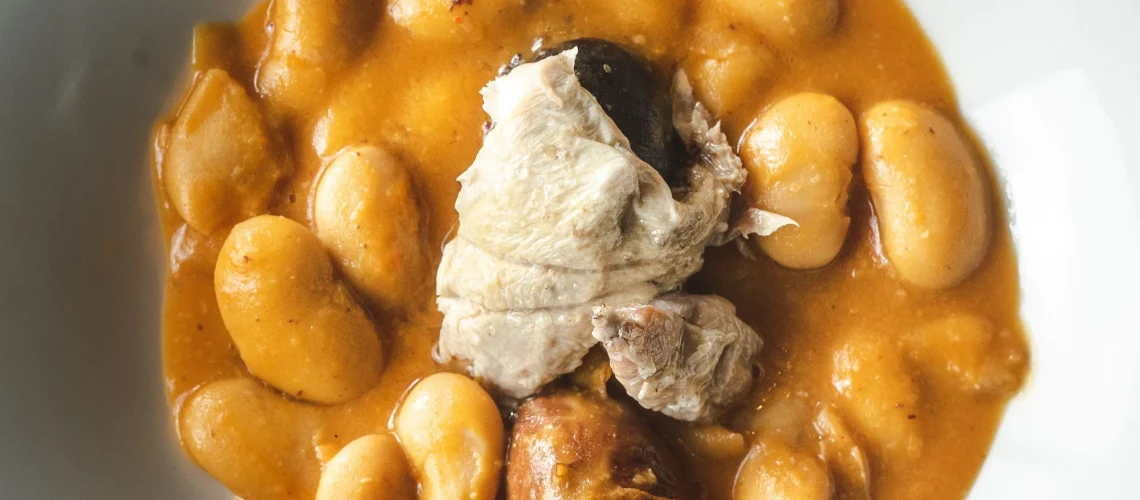
Fabada asturiana is a spoon dish that asks for time, gentle heat and good ingredients. That is the whole secret. At Finca El Ribeiro, a family farm in San Martín de Luiña, in Cudillero, we grow, dry and pack our own Faba Asturiana PGI de La Granja, so fabada is the house dish for us above all others. Here is the traditional recipe step by step, with timings for a regular pot and for a pressure cooker.
Fabada asturiana ingredients for 4 people
The ingredient list for fabada asturiana is short. What makes the difference is the quality of each one.
- Fabas. 400 g of Faba Asturiana PGI, which makes four generous servings. With 1 kg you get 8 to 10 servings.
- Asturian chorizo. 2 cooking chorizos.
- Asturian morcilla. 2 blood sausages (morcillas).
- Fresh pork belly. 150 g, in a single piece (tocino).
- Lacón. 150 g, or a piece of bone-in ham if you prefer.
- Saffron. A few strands, briefly toasted and crushed.
- Salt. At the end, and not much, because the cured meats already add plenty.
The set of chorizo, morcilla, pork belly and lacón is called compango. If the lacón or the pork belly are salted, put them in cold water the night before, together with the fabas.

How to prepare Asturian fabes before cooking
Soaking
Put the fabas in a large bowl with plenty of cold water the night before. We recommend about 12 hours, although 8 will also do. The next day you will see that they have grown and the skin looks smooth. Drain them and throw away the soaking water.
The compango
Wash the compango in lukewarm water. If the pork belly is very salty, it is better if it has spent the night soaking. Prick the chorizo and the morcilla with a toothpick only if you see them splitting open a lot, and there is no need to touch them any more than that.
Traditional fabada asturiana step by step in a regular pot
- Everything in the pot. Put the drained fabas, the lacón, the pork belly, the chorizo and the morcilla in a tall pot. Cover with cold water, just enough to rise two fingers above the beans.
- First boil. Heat over medium heat and skim off the foam that rises with a slotted spoon. When it comes to a boil, lower the heat.
- Scaring the fabas. Add a splash of cold water to stop the boil. This is what is called asustar las fabes, or scaring the fabes. Repeat this three times, each time it starts boiling again. That way the skin does not break and the beans cook evenly.
- The saffron. Add the crushed strands, dissolved in a little broth.
- Slow cooking. Leave the pot over very low heat, covered but with a small gap, for about two hours. The broth should barely move, with a shy bubbling.
- No stirring. Never put a spoon in. If needed, hold the pot by the handles and move it with a gentle back and forth swing so the fabas do not stick.
- Salt and resting. Taste the fabas towards the end. If the beans are tender and creamy, adjust the salt. Turn off the heat and let it rest covered for at least 20 minutes.
A grandmother’s fabada is always served with a bound, thick broth. That texture comes without adding anything, only with patience and with the starch of the faba itself.
Fabada asturiana recipe in a pressure cooker
If you are looking for a fabada asturiana recipe for the pressure cooker because you have less time, it works very well following these steps.
- Put the soaked fabas, the compango and cold water in the cooker, just enough to cover, without going over two thirds of its capacity.
- Bring to a boil with the lid off and skim the foam. Scare the beans with a splash of cold water twice.
- Add the saffron, close the cooker and wait for the pressure to build up.
- Lower the heat and count about 25 to 30 minutes from when it starts to whistle, depending on what your cooker needs.
- Turn off the heat and let the pressure drop on its own, without forcing it open. This is important so the skin does not break.
- Open, taste, adjust the salt and let it rest with the lid off for about 15 minutes.
The result is not identical to the clay pot over a slow fire, but it comes out very good for a weekday.
Tips for a creamy fabada
- Always cold water. Starting with hot water hardens the skin.
- Gentle heat. A strong boil breaks the fabas and leaves the broth cloudy.
- No stirring. Move the pot, not the spoon.
- Resting. The next day the fabada is even better, because the broth finishes binding.
- A thin-skinned faba. Our faba has a very thin skin and a creamy, almost buttery texture. That is why it handles slow cooking well without falling apart.
If you want to know more about how we look after the crop, you can read about it on our faba page. And if you want to check that the bag you are buying is genuine, read how to recognise authentic Faba Asturiana PGI.
How to serve and store fabada
It is served in a deep plate, with a little of each piece of the compango. Many households accompany it with a glass of natural cider. Leftovers keep for three days in the fridge in a covered container. It can also be frozen, although it is better to do so without the pork belly and the morcilla, which can be added again when reheating.
For a plan without cooking, we also have our ready-made Fabada Asturiana Tradicional, made by Astursabor. You only need to heat it.
Frequently asked questions about fabada asturiana
What ingredients does traditional fabada asturiana have?
It has fabas, chorizo, morcilla, pork belly, lacón, saffron and salt. No vegetables or other seasonings are added. It is a simple recipe in which the faba and the compango take the lead.
How long does fabada need to cook?
In a regular pot, about two hours over very low heat after scaring the fabas. In a pressure cooker, between 25 and 30 minutes from when the pressure builds up. In both cases it is best to let it rest.
Do fabes need to be soaked?
Yes, the best practice is to leave them in cold water from the night before. That way they hydrate evenly and the cooking is shorter and gentler.
Why do you scare the fabes?
Because a splash of cold water stops the boil and keeps the skin from breaking. It is repeated three times in a regular pot. It helps the beans stay whole and creamy.
How many servings come from a kilo of faba?
A kilo of our faba gives between 8 and 10 servings. For four people, about 400 g is enough.
Try the recipe with faba from the farm
If you want to make this fabada with our Faba Asturiana PGI de La Granja, you can find it in our fabas shop. And if you are looking for more ideas for cooking them, drop by the recipes.