In Asturias, faba de la granja is the name for the long white bean that goes into fabada. The name comes from the variety, Granja Asturiana, not from a place. We have grown it since 2009 in San Martín de Luiña, in the municipality of Cudillero, and these are the things worth knowing about it before you buy a bag and put it on the hob.
Where the name comes from
Granja Asturiana is a traditional bean variety of the species Phaseolus vulgaris, the same species as most dried beans. Within it there are selections. We sow Andecha, a selection of Granja Asturiana that SERIDA, the Asturian agricultural research centre, regards as the prototype of the faba granja.
In everyday speech the name gets shortened. Faba de la granja, fabes de la granja, faba granja or simply faba. They all mean the same thing. The confusion starts with the judión de La Granja, which comes from Segovia, shares the surname and is a different legume of a different species. We explain it in judión de La Granja and Asturian faba, the differences.
Faba de la granja and Faba Asturiana PGI are not the same thing
Granja seed can be sown in any vegetable garden, inside or outside Asturias. What not everyone can do is sell it as Faba Asturiana. According to the Regulatory Council, only registered growers may produce granja beans destined for the PGI, and growing, processing and packing all have to happen in Asturias. The beans must fall within the Extra or First categories, arrive sound and whole and contain no more than 15% moisture.
A granja bean from somewhere else can turn out well. What it lacks is that control behind it. To know which one you are looking at, check the packet. Faba Asturiana PGI is always packed and carries the numbered back label of the Regulatory Council, and it is never sold loose. The seals and pack sizes are explained in where to buy Asturian fabes PGI.
How to recognise a good faba de la granja
With the packet in your hand you can already tell a lot.
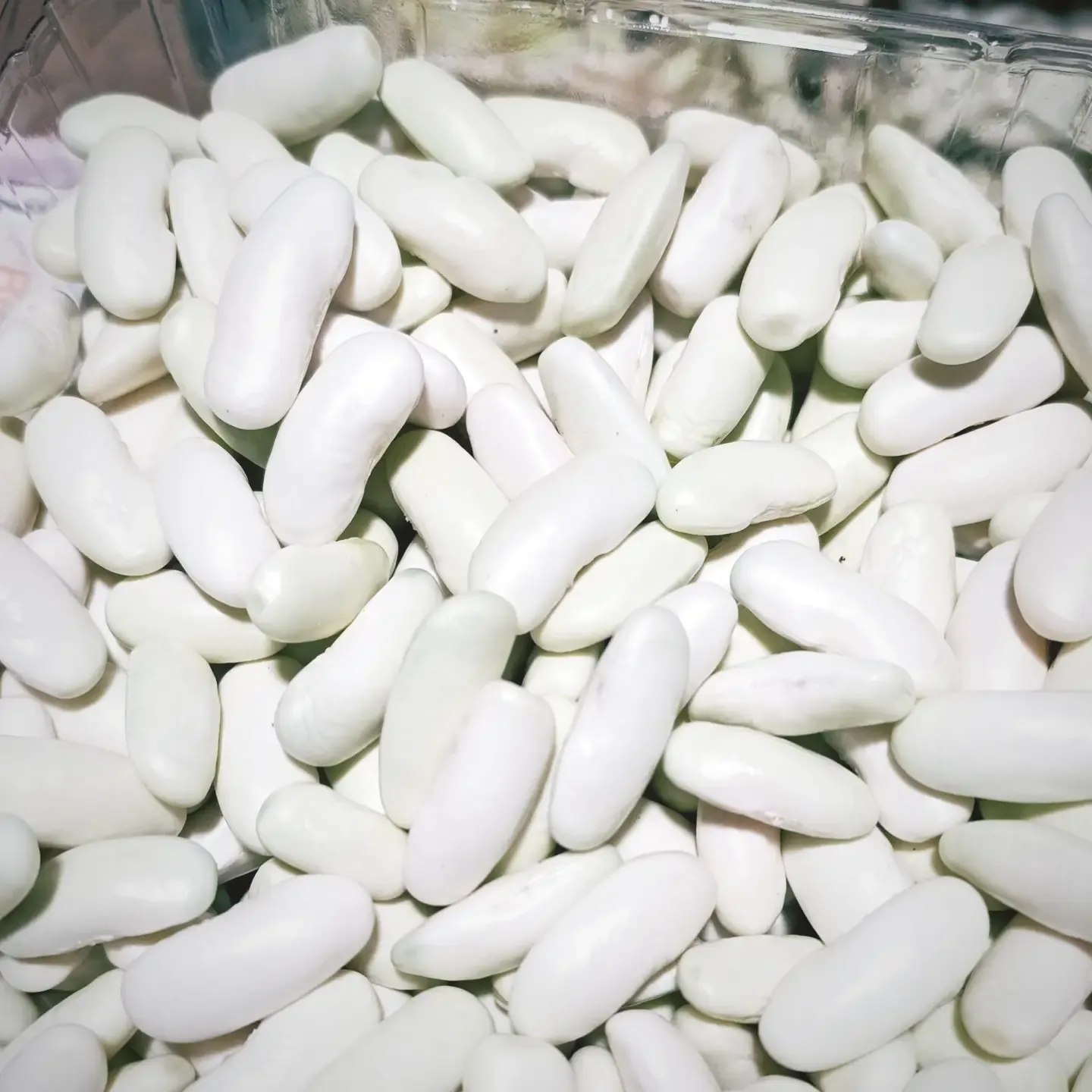
- Shape. Long and flat, with a white background. The Regulatory Council sets a minimum length of 18 millimetres, so a granja bean is close to two centimetres long.
- Evenness. Beans that look alike. Lots of mixed sizes mean the sorting has been careless.
- Skin. Smooth and glossy, with no wrinkles, dark marks or pitted beans.
- Next to other beans. Beside an ordinary white bean, the granja is clearly longer and flatter. Beside a judión, it is smaller and slimmer.
The other test comes in the pot. A good faba de la granja swells evenly as it soaks, stays whole as it cooks and ends up with a barely noticeable skin and a creamy centre. We do not rely on our eyes alone. Every year we send a random sample of the harvest to the Instituto Tecnológico Agrario de Castilla y León for sensory and physico-chemical analysis, and the results are published on our faba page.
If what you need is to compare brands on the shelf, the criteria are set out one by one in what is the best Asturian faba.
Fresh and dried faba de la granja
At the end of summer fresh faba appears at the markets. It is the same faba de la granja, picked once the bean has formed but before it dries. The pods are yellow or yellowish green, stiff and plump, and the beans are bigger and hold much more water, around 60% moisture. It needs no soaking and cooks faster.
Fresh faba lasts only a few weeks and is not Faba Asturiana PGI, because the indication covers dried beans only. If you have some left over, it can be frozen. We explain how in can you freeze fabes.
How to cook faba de la granja
Dried faba asks for three things. Soaking in cold water from the night before, a very gentle heat and no spoon in the pot, because it breaks the skins. One kilo makes 8 to 10 servings. Times for an ordinary pan and a pressure cooker are in how to cook fabes.
From there, granja works in almost any slow-cooked dish.
- Fabada. The classic, with its compango. There is the traditional recipe step by step and a guide to what compango is.
- With seafood. Fabes with clams, with prawns and seafood or with octopus.
- With cabbage. Pote asturiano, more of a winter dish.
On days with no time for soaking, we have our traditional fabada asturiana and fabas in vinaigrette ready made. There are more ideas in recipes with our produce.
Our faba de la granja
We started in May 2009 with a 2,000 square metre plot and today we farm almost five hectares. Part of it is organic, certified by COPAE, and there the pods are picked by hand, one by one. In the conventional part the plants are cut and hung in our 288 square metre drying shed. We pack our own brand of Faba Asturiana PGI.
In 2026 our faba was named Mejor Faba Asturiana IGP, the best Faba Asturiana PGI, at the XVIII Certamen de la Primera Flor de Grado, held on 12 April. You will find it in the faba section of the shop, and if you would like to see the fields, we run guided visits at 12:00 and 17:30, booked on the Finca El Ribeiro visit page.
Sources
- Regulatory Council of the Faba Asturiana PGI, the product, with the variety, bean measurements, categories and maximum moisture.
- Regulatory Council of the Faba Asturiana PGI, frequently asked questions, on registered growers, back labels and loose sales.
- SERIDA, Maruxa, una nueva variedad de faba granja para un cultivo más rentable y sostenible, Tecnología Agroalimentaria no. 12, which describes the Andecha variety.
Frequently asked questions
What is faba de la granja?
It is the bean of the traditional Granja Asturiana variety, of the species Phaseolus vulgaris. It is a long white bean with a thin skin and a buttery texture, and it is the bean used for fabada.
Is all faba de la granja Faba Asturiana PGI?
No. Granja seed can be grown anywhere. Only beans grown by registered producers in Asturias and packed with the numbered back label of the Regulatory Council are Faba Asturiana PGI.
How do you recognise a good faba de la granja?
By a long, flat bean close to two centimetres long, even in size, with a smooth skin and no marks. In the kitchen, because it cooks whole and turns creamy.
Does fresh faba de la granja need soaking?
No. Fresh faba is picked before it dries and has around 60% moisture, so it goes straight into the pot and cooks faster than dried beans.
Are faba de la granja and judión de La Granja the same?
No. Faba de la granja is Asturian and takes its name from the Granja Asturiana variety. Judión de La Granja comes from Segovia and belongs to another species, Phaseolus coccineus.